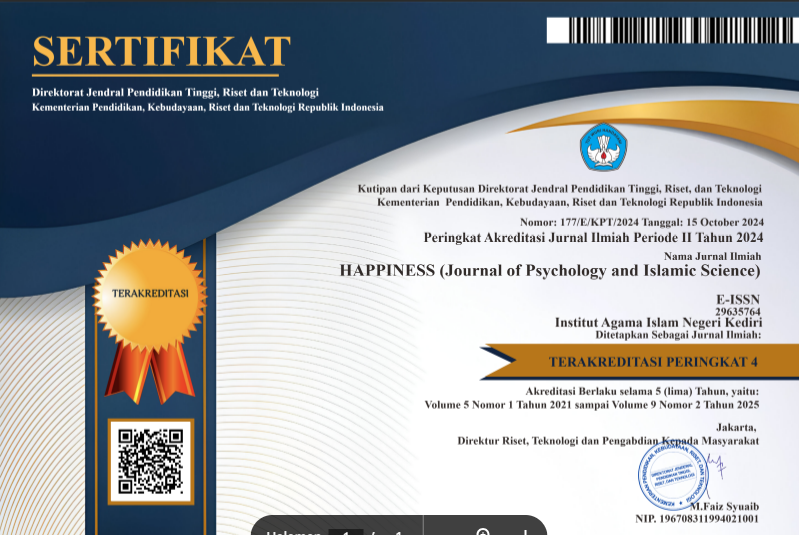
Efektivitas Metode Token Ekonomi dalam Meningkatkan Perilaku Disiplin pada Siswa Kelas IV SDN (The Effectiveness of the Token Economy Method in Improving Disciplinary Behavior among Fourth-Grade Students at SDN)
DOI:
https://doi.org/10.30762/happiness.v9i2.3328Keywords:
Discipline, elementary school students, token economyAbstract
Discipline is a form of students’ attitudes and behaviors in the school environment that reflects obedience to rules, self-control, and commitment to fulfilling responsibilities with full awareness. However, observations of fourth-grade students at SDN Satak 2 revealed a lack of disciplinary behavior, such as not wearing the prescribed uniform, failing to complete assignments on time, not maintaining order during learning activities, and neglecting classroom duty schedules. These behavioral issues encouraged the researcher to implement a token economy intervention. This study aimed to examine whether the token economy method could improve the disciplinary behavior of fourth-grade students at SDN Satak 2 Puncu, Kediri. This study employed a quantitative method with an experimental approach using a one-group pretest–posttest design. Data were collected through questionnaires, observations, and documentation. The population of this study consisted of all fourth-grade students at SDN Satak 2, totaling 14 students, and the sample included the entire population using a saturated sampling technique. The results showed an increase in the mean score from 43.79 in the pretest to 62.86 in the posttest. The Wilcoxon Signed-Rank Test yielded a significance value of 0.001 (p < 0.05), indicating a statistically significant difference before and after the implementation of the token economy method. The N-Gain value was 0.7986, which falls into the high category, indicating a substantial improvement in scores. Therefore, the token economy method is proven to be effective in improving the disciplinary behavior of fourth-grade students at SDN Satak 2 Puncu, Kediri.
Downloads
References
Aidina, W., & Salsabila, S. (2025). Penerapan Teknik Token Ekonomi Untuk Meningkatkan Perilaku On-Task Pada Anak Dengan Pencapaian Akademik Rendah. Paedagogy: Jurnal Ilmu Pendidikan Dan Psikologi, 5(2), 542–557. https://doi.org/10.51878/paedagogy.v5i2.6087
Aprilia, F., & Wardhani, J. D. (2023). Efektivitas penerapan metode token ekonomi terhadap tingkat kedisiplinan anak usia dini. 7(2).
Astuti, F. (2024). Statistika psikologi. PT. Literasi Nusantara Abadi Grup.
Aulia, D., Yuliati, N., & Dienda Saputri, S. W. (2022). Pengaruh penerapan teknik token ekonomi terhadap tingkat kedisiplinan siswa. JPGI (Jurnal Penelitian Guru Indonesia), 7(1), 104. https://doi.org/10.29210/021585jpgi0005
Barker, A., Matson, J. L., & Konst, M. J. (2023). Methodological variations in the implementation and evaluation of token economies. 139.
Deniati, E., Jayanti, D. D., Fitriana, D., & Jihansyah, I. (2023). Efektivitas Pemberian Reward Melalui Metode Token Ekonomi Untuk Meningkatkan Kedisiplinan Anak Usia Dini 4-6. JCE (Journal of Childhood Education), 7(1), 187–192. https://doi.org/10.30736/jce.v7i1.1698
Duckworth, A. L., Taxer, J. L., Eskreis-Winkler, L., Galla, B. M., & Gross, J. J. (2022). Self-control and academic achievement: A systematic review and meta-analysis of discipline-based interventions. 114(4), 842–861.
Hermawan, A., Sano, A., & Ifdil, I. (2022). Stages of behavior modification training: Preparation, implementation, and evaluation of token economy for educators. 28(1), 45-53.
Hurlock, E. B. (2015). Psikologi perkembangan: Suatu pendekatan sepanjang rentang kehidupan. Erlangga.
Ivy, J. W., Meindl, J. N., Overley, E., & Robson, K. (2021). Economies in the classroom: A review of the literature from 2000 to 2019. 45(4), 543-573.
Kestian, N. D., Syahrial, S., & Kurniawan, O. (2024). Implementation of token economy behavior modification to improve student learning discipline in elementary schools. 5(2), 189-198.
Maggin, D. M., Chafouleas, S. M., Goddard, K. M., & Johnson, A. H. (2021). A systematic review of token economies in early childhood education settings: Maintenance and generalization of disciplinary behaviors. 23(2), 114-127.
Matson, J. L., Barker, A., & Konst, M. J. (2023). The evolution of token economies in the treatment of individuals with developmental disabilities. 136.
Nugroho, F. S., Prasetyo, B., & Utami, S. (2023). Konformitas normatif sebagai strategi aktif dalam menjaga keharmonisan hubungan interreligius di perguruan tinggi. 14(2).
Prawitasari, T., & Antika, E. R. (2022). Pengaruh self-efficacy terhadap resiliensi akademik siswa. 7(2), 1–9.
Purnomo, R. A. A., Susanto, A. R. A., & Oktavianisa, N. A. (2024). The Role of Self Efficacy on Academic Procrastination among University Student. Jurnal Psikologi Teori Dan Terapan, 15(01), 74–86. https://doi.org/10.26740/jptt.v15n01.p74-86
Purwanta, E. (2012). Modifikasi perilaku: Alternatif penanganan anak berkebutuhan khusus. Pustaka Belajar.
Rizkiana, F., & Hartono, R. (2022). Analisis dimensi disiplin siswa: Hubungan ketertiban sekolah dan konsentrasi belajar di kelas. 10(1), 34-45.
Rohmaniah, A., Tegeh, I. M., & Magta, M. (2016). Penerapan Metode Token Ekonomi untuk Meningkatkan Kedisiplinan Anak. 4(3), 1–10.
Santrock, J. W. (2018). Life-Span Development (Seventeenth edition). McGraw -Hill Education.
Sari, P. K., & Handayani, T. (2023). Efektivitas modifikasi perilaku token ekonomi terhadap kedisiplinan anak usia 5-6 tahun. Jurnal Obsesi: Jurnal Pendidikan Anak Usia Dini, 7(2), 1541-1552.
Sobri, M. (2020). Kontribusi kemandirian dan kedisiplinan terhadap hasil belajar. Guepedia.
Sugiyono. (2022). Metode Penelitian Kuantitatif, Kualitatif, dan R&D (Edisi 3). Alfabeta.
Sullivan, K., Radley, K. C., Clark, R. R., & Dart, E. H. (2022). Peer-mediated token economy to increase classroom discipline and engagement in preschool classrooms. 45(3).
Tang, Y., Prawira, S., & Zhou, Q. (2023). Restructuring student discipline in modern schools: Orderliness, self-control, and task concentration as core behavioral metrics. 9(8).
Tu’u, T. (2004). Peran Disiplin pada Perilaku dan Prestasi Belajar. PT Grasindo.
Warshawski, S. (2022). Academic self-efficacy, resilience and social support among first-year students learning in complex environments. 110.
Widjaja, A., & Santoso, B. (2023). Pergeseran paradigma disiplin sekolah: Dari kepatuhan eksternal menuju regulasi diri kognitif siswa. 12(2), 89-101.
Widodo, A., & Wardani, R. K. (2022). Mengembangkan kedisiplinan dan efikasi diri siswa melalui penguatan regulasi diri dalam pembelajaran blended learning. 9(1), 45–56.
Wijaya, M. A., Pratama, N., & Lestari, S. (2021). Konstruksi instrumen disiplin siswa berbasis regulasi perilaku dan ketaatan tata tertib sekolah. 9(2), 112-125.
Woolfolk, A. (2020). Educational psychology. Pearson.
Zimmerman, B. J., & Cleary, T.J. (2021). Self-regulation and academic discipline: Transforming willpower into inherent learning skills. Educational Psychologist. 56(2), 115-129.
Downloads
Published
How to Cite
Issue
Section
License
Copyright (c) 2025 Denisa Yulianti, M. Qomarul Huda, Shofi Mirwani

This work is licensed under a Creative Commons Attribution-ShareAlike 4.0 International License.